

AI chatbots gain ground in Asia’s hospitals – Case study of Primaya’s Sasya chatbot
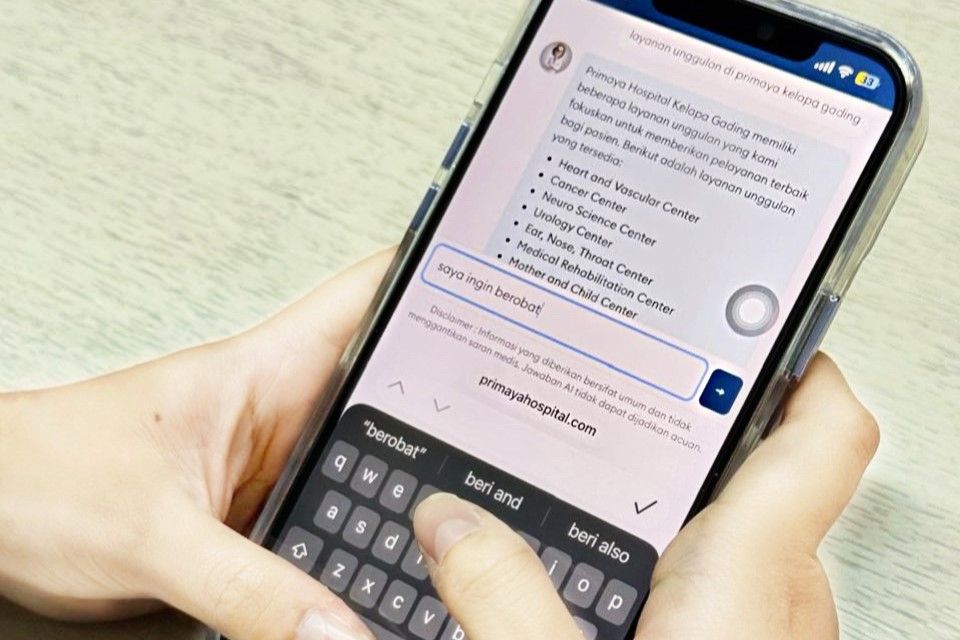
Indonesia’s Primaya Hospital Group launched its AI chatbot, Sasya, in August 2025. Already, it has shown success in streamlining patient journeys and easing frontline workloads.
As Artificial Intelligence (AI) in healthcare rapidly shifts from concept to everyday practice, one tool stands out for its rising adoption and demand: the AI chatbot.
AI-powered chatbots use natural language processing (NLP) and machine learning (ML) to understand user input and simulate human conversation. Unlike rule-based chatbots of the past, newer chatbots backed by smarter algorithms now generate more dynamic and natural responses to questions.
This is good news for hospitals under pressure to deliver faster, smoother care experience while grappling with rising costs. Chatbots can help ease the load on both frontline staff and customer service teams by providing quick, accurate, and personalised responses to patients and their families – anytime, anywhere.
Hospitals worldwide are catching on. The global healthcare chatbot market is expected to quadruple to USD8.25 billion by 2032, and Asia is very much part of this growth.
In Indonesia, Primaya Hospital Group, a private network of 20 hospitals, introduced its new AI chatbot, Sasya, in August 2025.
Sasya – short for Sahabat Sehat Primaya, or Primaya’s Health Companion – was developed with two key goals in mind: to reduce friction in the patient journey, and to support frontline teams in delivering fast access to healthcare, said Hendra Suherman, Head of Digital Marketing at Primaya.
“Primaya manages millions of patient interactions every year, many of which are routine inquiries such as appointment requests, medical-related questions, and insurance verification. Before Sasya, most of these were handled manually, leading to long response time and significant operational resources,” he pointed out.
While the hospital group had previously introduced a Whatsapp chatbot, it was template-based and fairly limited in functionality.
“Sasya was designed not as a typical chatbot, but as a conversational agent AI assistant, supporting the entire patient journey from symptom awareness to choosing the right doctors and navigating our services,” said Hendra. “It keeps track of users’ context and intent, and asks follow-up questions just like a normal conversation. Most importantly, there is no waiting time. Every patient receives immediate assistance any time they need it, 24/7.”

Building a healthcare AI chatbot
Development on Sasya began in 2023, with the utilisation of Google’s advanced AI technology. Sasya was built using Google’s AI infrastructure and operates on a healthcare-optimised large language model.
A critical part of the development process was building a robust and accurate knowledge base, said Primaya’s CRM coordinator, Prayataneswara Dwiputri Susanto.
“Firstly, we needed an accurate and updated knowledge base for each category of patient queries, such as doctor profiles, schedules, hospital facilities, and clinical services. From there, we trained Sasya to answer only from this verified information,” she noted. “We also connected Sasya via API to our hospital information system and website for real-time updates.”
For appointment requests, Sasya guides patients to a registration page directly linked to the hospital information system, ensuring a seamless booking experience.
Chatbot security and privacy considerations
As with any technology, security and governance risk management remain essential.
While Sasya is built on a validated clinical database, the team makes it clear to users that chatbot responses should not be taken as formal medical advice. The chatbot is programmed not to provide medication recommendations, and to direct any such questions to the call centre.
In terms of data privacy, Praya emphasised that data collected in Sasya is securely encrypted, and personal identifiers are anonymised. Unlike ChatGPT, historical data is not stored within Sasya but within the hospital information system, with tightly controlled access.
Impact of chatbot on efficiency and revenue
Although newly launched, Sasya is already handling hundreds to thousands of queries each month. As usage grows, the chatbot is expected to further ease the workload of call centres and frontline staff.
So far, the hospital has a significant number of patient referrals from the chatbot. As of October 2025, it brought in billions of rupiah in revenue, with these referred patients making up around 30% of total patient volume from web-based appointments. A significant proportion comes from expecting mothers, who often consult Sasya about delivery procedures and available obstetric technologies before making a decision.
“The chatbot has been a very cost-efficient platform for us,” Praya added. “We only spend around several hundred thousand rupiah a month on platform maintenance so it is a huge margin; this is only expected to grow from here.”

Patient needs at the centre of AI adoption
With this early success, the team is already planning further enhancements for Sasya.
“More complicated queries such as those around hospital tariffs or insurance are still being directed to our contact centre,” said Praya. “In time, we hope to expand Sasya’s database and features so it can take on a larger share of queries.”
Sasya represents one of many efforts by Primaya Hospital Group to become a trusted healthcare destination that emphasises clinical excellence with compassion for the people of Indonesia. Primaya has also launched a community page on its website where users can post medical-related questions and receive answers from fellow community members or an AI-powered ‘doctor’. This AI model draws on Google’s medical knowledge base as well as articles written by Primaya’s own doctors.
Patients can look forward to more AI-driven innovations at Primaya in the future, said Hendra, noting several projects are already in the pipeline.
“Any AI technologies we adopt or build revolves around our patients – how they would resolve our patients’ pain points or better address their needs. Ultimately, our goal is to deliver service excellence and premium value to all our patients,” he concluded.