

Hospital-at-Home trends in Asia 2026
)
From pilot projects to integration within mainstream care, here’s a look at the progress of Hospital-at-Home care in Asia.
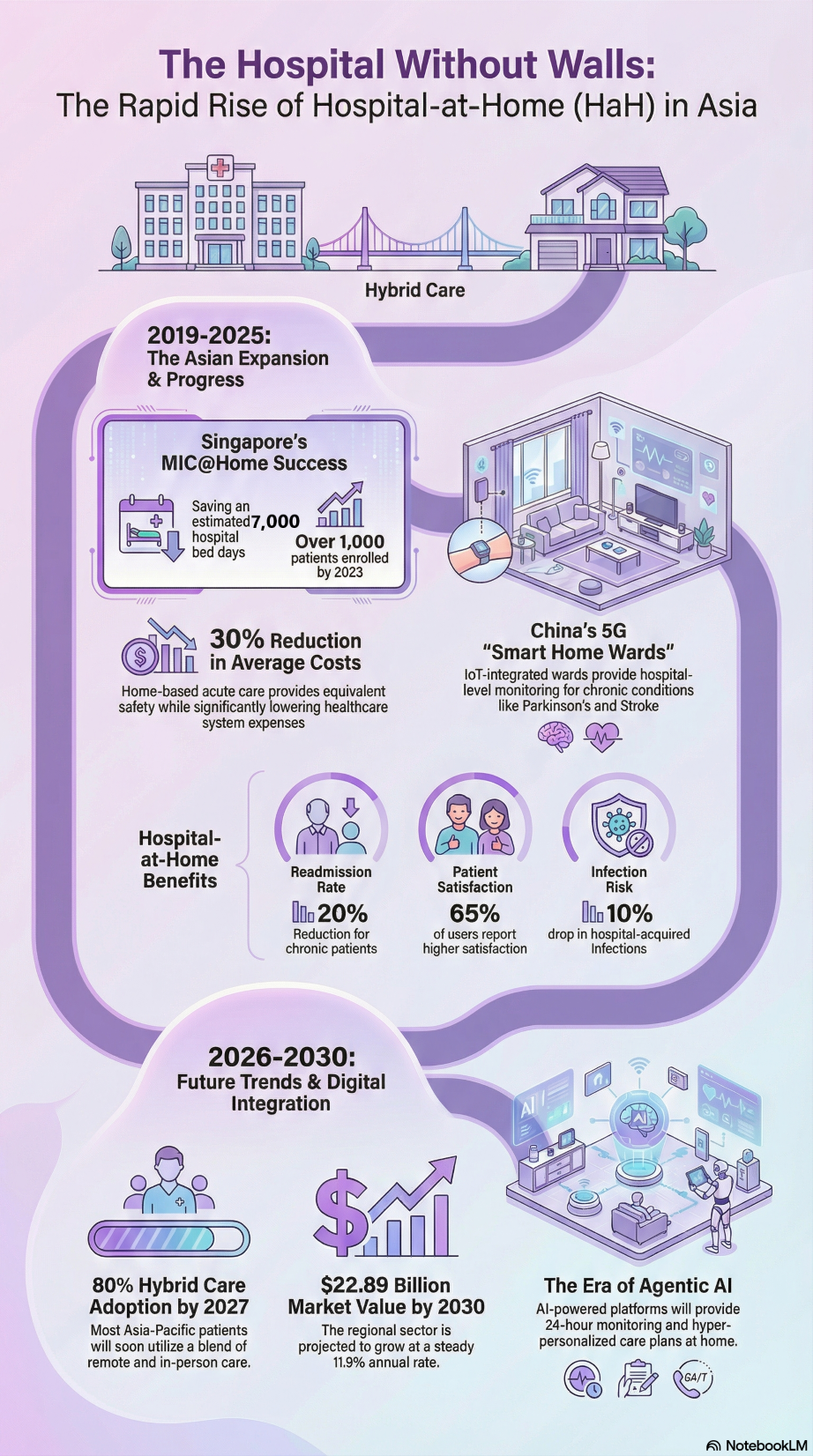
Hospital-at-Home (HaH) models have rapidly transitioned from experimental pilots to becoming integrated in mainstream healthcare. In 2023, over 4.8 million patients globally were treated under HaH programmes. In the US alone, over 250 health systems now offer HaH services.
Here in Asia-Pacific, Singapore has successfully integrated its Mobile Inpatient Care at Home (MIC@Home) initiative into all public hospitals. A recent study of patients admitted between January 2021 and May 2023 found that for suitable patients, HaH care costs less than ward-based care – at about 23% lower cost per episode – with no significant difference in clinical outcomes.
China’s Guangdong Second Provincial General Hospital has pioneered 5G-powered smart home wards, leveraging a variety of connected smart wearables and devices for hospital-level monitoring. In 2024, the National Health Insurance Administration of Taiwan launched a national pilot HaH scheme, covering common geriatric infections as a start.
These examples point to the continued expansion of “hospitals without walls” in Asia, as healthcare systems seek to manage the dual pressures of aging populations and rising costs.
Alongside escalating demand for care, rapidly advancing technologies (especially AI), and rising digital literacy rates, researchers estimate that by 2027, 80% of patients in the region will utilise hybrid care – a mix of traditional face-to-face visits and digital touchpoints for more efficient and responsive care.
This digital evolution is set to drive HaH’s reach across the entire care continuum, incorporating virtual emergency departments and virtual triaging to deliver seamless continuity from community touchpoints to acute recovery settings.